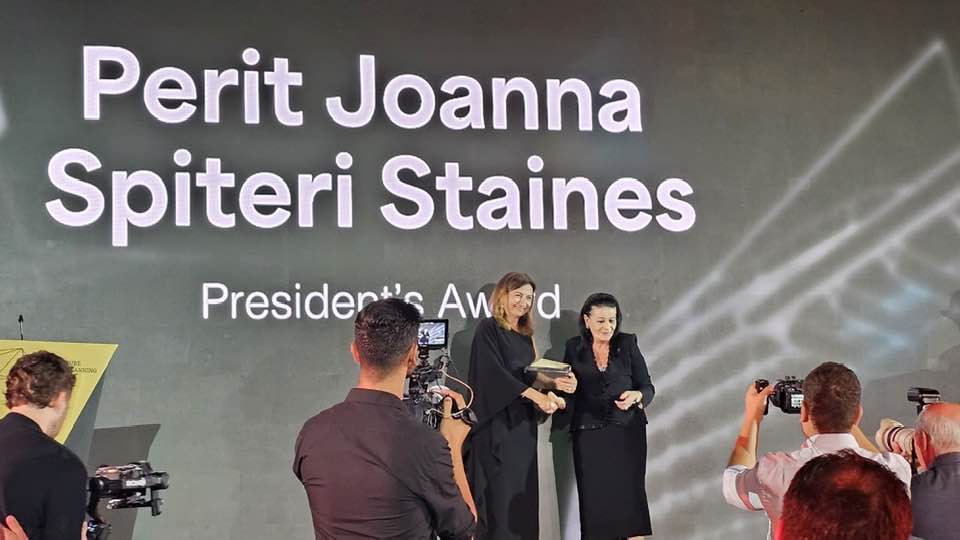
Joanna Spiteri Staines, architect and founding partner of Openworkstudio, has been named this year’s recipient of the President Award by the Malta Architecture and Spatial Planning (MASP) Awards, a programme organised by the Planning Authority and held under the patronage of the President of Malta.
“We’re incredibly proud to share that one of our partners Joanna Spiteri Staines has been honoured with the President’s Award at the MASP Awards,” Openworkstudio shared. “This recognition highlights their outstanding leadership, dedication, and impact in the industry. Congratulations on this well-deserved achievement! Your hard work continues to inspire us all.”

Previous recipients of the award include Richard England (2023), Conrad Thake (2022), Konrad Buhagiar (2021) and Joseph M. Spiteri (post-humous), making Joanna the first female recipient of this award.
Joanna began her professional career at Architecture Project (AP) in 1993, becoming an associate partner in 2005. Throughout this time, she worked on several large-scale and historically-sensitive projects, including the Malta Stock Exchange (2001) which is housed within the British Garrison Chapel in Valletta.
She also played a leading role in the conceptual design and masterplan for the Pinto Stores and Grand Harbour Cruise Liner Terminal, a project that went on to receive national and international accolades.
Joanna co-founded Openworkstudio in 2016, an architecture practice that provides architecture, interior design, master planning, restoration consultancy, and environmental design crafted through research and creativity, backed by years of experience.
She also co-founded a collaborative platform for design professionals called NIDUM, which won the international competition for the Gozo Museum in 2016, with Joanna serving as design director for the ongoing project.
An avid advocate for architectural heritage, Joanna has collaborated with Din l-Art Ħelwa since 2006, serving as a judge for its annual Architectural Heritage Awards since 2012.
Her work is primarily focused on cultural projects and interventions within historic buildings, blending traditional techniques with contemporary design to create architecture with a strong sense of place.
Main image: Openworkstudio